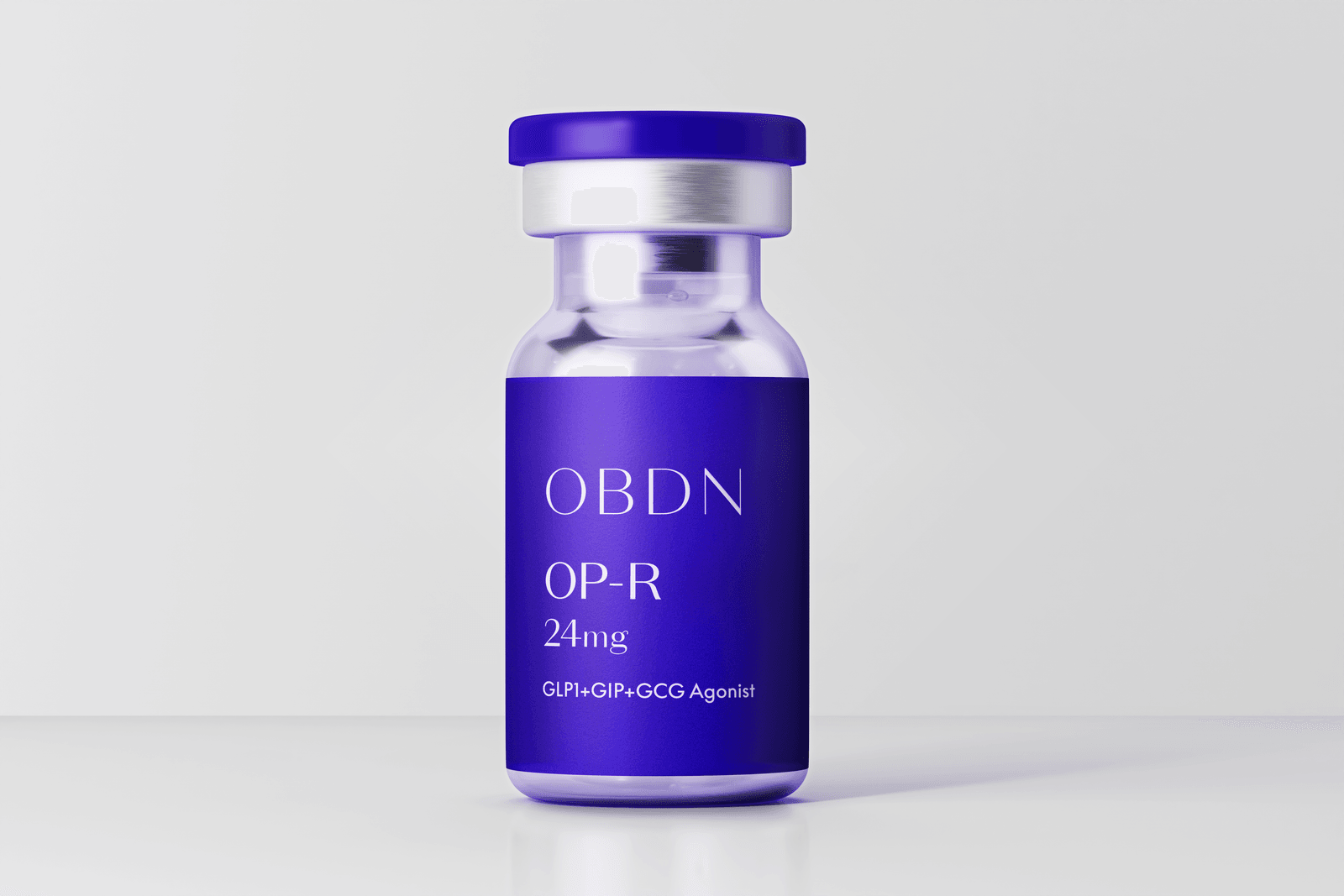
Retatrutide is a triple-agonist — a single molecule engaging GLP-1, GIP, and glucagon receptors simultaneously.
The three pathways are tuned to work in coordination:
• GIP (2× native) — insulin efficiency, adipose signaling
• GLP-1 (0.5× native) — appetite moderation
• Glucagon (0.2× native) — hepatic fat mobilization, metabolic rate maintenance
In 48-week Phase 2 trials, it showed 24% weight loss and 86% liver fat reduction — numbers that exceed both single-agonist (semaglutide) and dual-agonist (tirzepatide) compounds.
The glucagon pathway is the key differentiator: it signals the liver to mobilize and oxidize stored triglycerides directly, and counteracts the metabolic slowdown typical of weight loss with a modest heart rate increase (2-7 bpm in trials).
Phase III trials are ongoing.
Made in USA•Purity: 99% HPLC
Phase 2 RCTs demonstrating 24% weight loss and 86% liver fat reduction; Phase 3 trials in progress for obesity and MASLD indications
This content summarizes published research for educational purposes. It is not medical advice.
Research summary based on 7 peer-reviewed sources•Last updated: February 13, 2026•View references ↓
Retatrutide adds glucagon receptor activation to the GIP/GLP-1 dual-agonist framework — producing mechanistically distinct hepatic effects not seen with tirzepatide or semaglutide.
GLP-1 and GIP reduce liver fat passively: less intake → less substrate for hepatic lipogenesis. Glucagon receptor activation works differently — it signals hepatocytes to mobilize and oxidize stored triglycerides directly.
This distinction explains the magnitude difference in outcomes:
The glucagon component maintains resting energy expenditure during caloric deficit, counteracting the metabolic slowdown typical of weight loss.
Trade-off: resting heart rate increases of 2–7 bpm (peaking ~week 24, partially attenuating by week 48). Arrhythmia incidence was elevated (4–14% vs 2–3% placebo) though none classified as serious.
DXA substudy (Lancet, T2D population, 48 weeks) showed ~63:37 fat-to-lean ratio — between semaglutide (~60:40) and tirzepatide (~75:25 in non-diabetics).
Critical caveat: body composition tested only in T2D where GIP signaling is impaired. The 2× GIP affinity may produce more favorable ratios in non-diabetics, but this remains untested.
The three receptors are tuned to coordinate rather than compete:
A 48-week trial in 338 adults with obesity (BMI 30–50) showed dose-dependent weight loss: 8.7% (1 mg), 17.3% (4 mg), 22.8% (8 mg), and 24.2% (12 mg) versus 2.1% with placebo. Gastrointestinal side effects (nausea, diarrhea) were most common during dose escalation.1
In a separate 48-week trial in adults with metabolic dysfunction-associated steatotic liver disease (MASLD), the 12 mg dose produced 86% relative reduction in liver fat measured by MRI. This exceeds reductions seen with GLP-1-only (~30%) or GLP-1/GIP dual agonists (~47%). The mechanism is glucagon-driven: direct triglyceride mobilization and oxidation in the liver.1
DXA analysis showed approximately 63:37 fat-to-lean mass loss ratio — meaning about 63% of weight lost came from fat, 37% from lean tissue. This was measured in people with type 2 diabetes, where GIP signaling is impaired. The ratio may be more favorable in non-diabetic populations, but that data does not yet exist. Resistance training and protein intake were not controlled in trials — variables that significantly affect lean mass preservation.1
Resting heart rate increases of 2–7 bpm were observed across doses — attributed to glucagon receptor activation. This is a distinguishing safety signal compared to compounds without glucagon activity and requires monitoring in cardiovascular risk phenotypes.1
All published data is Phase 2; Phase 3 trials are ongoing. Body composition data comes only from type 2 diabetes populations where GIP signaling is impaired. The 63:37 fat:lean ratio may improve in non-diabetics, but this remains untested. Heart rate increases require monitoring. The glucagon arm creates a double-edged profile: aggressive fat loss but proportional muscle loss risk without rigorous anabolic support (adequate protein, resistance training, and potentially GH-axis support). Regulatory status remains investigational (not yet FDA-approved); expected approval pending Phase 3 trial completion.
For laboratory research use only.
| Molecular Formula | C₂₇₂H₄₁₄N₇₂O₈₁S |
|---|---|
| Molecular Weight | ~6100 Da |
| Origin | Synthetic triple-receptor incretin engaging GLP-1 (0.5× native), GIP (2× native), and glucagon (0.2× native) pathways with tuned potency ratios |
| Synonyms | Retatrutide, LY3437943 |
This product ships as lyophilized (freeze-dried) powder. After reconstitution, the solution requires different storage conditions than the powder.
Do not freeze. Use within 30 days of mixing.