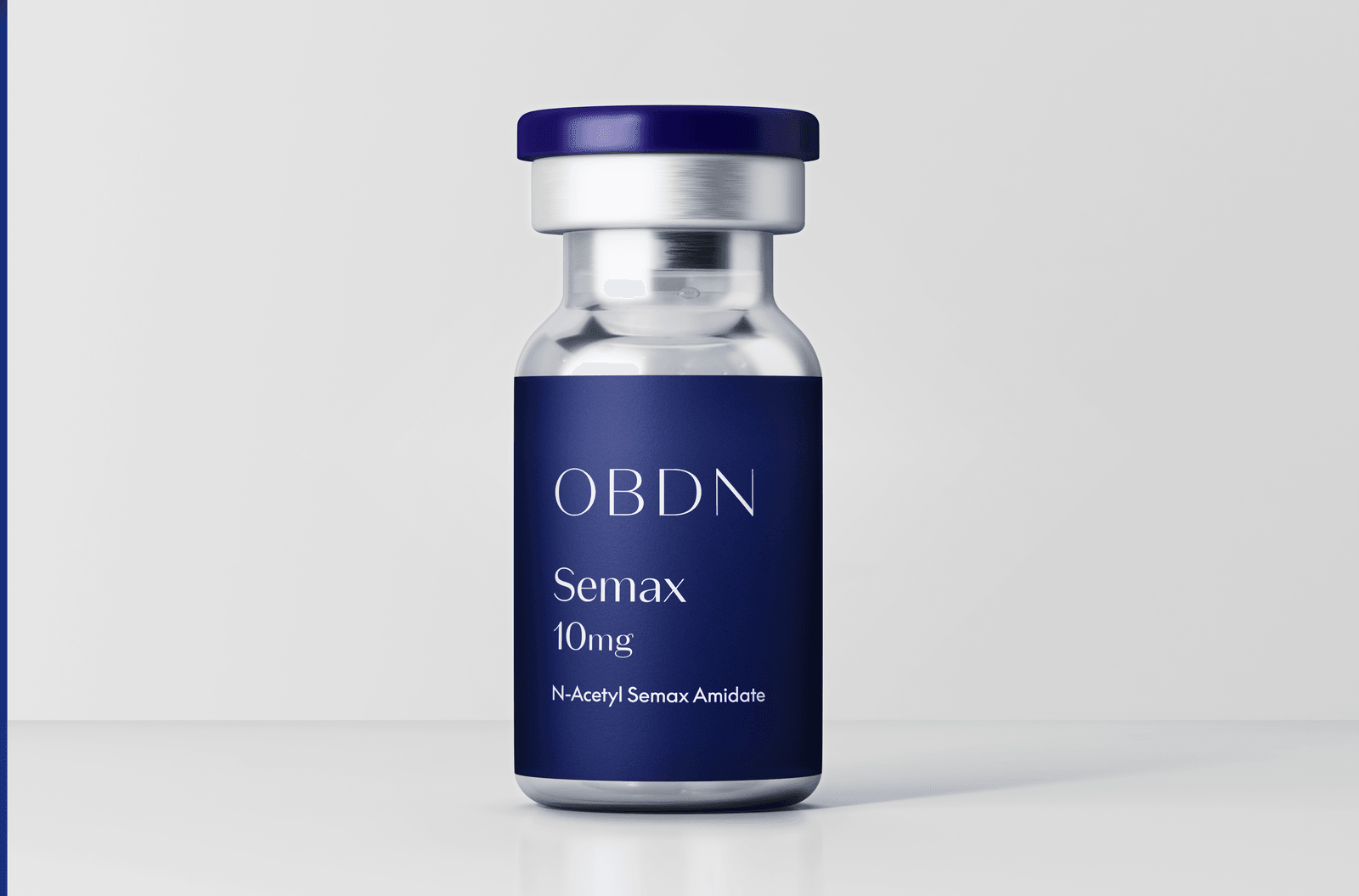
Low StockStudied for effects on BDNF — the neurotrophin involved in learning, memory consolidation, and neuronal adaptation — without activating stress-hormone pathways.
Derived from a fragment of ACTH, but modified (N-acetylation, C-amidation) to extend half-life and block the adrenocortical effects of the parent sequence.
A prescription medication in Russia since 2011, approved for stroke recovery, transient ischemic attack, and cognitive disorders. In a clinical trial of 110 stroke patients, intranasal Semax increased plasma BDNF levels.
Russian clinical trials in stroke recovery; 3-year follow-up showing continued improvement; BDNF biomarker confirmation in 110 patients
This content summarizes published research for educational purposes. It is not medical advice.
Research summary based on 8 peer-reviewed sources•Last updated: February 10, 2026•View references ↓
Semax has been studied in stroke recovery — and the results are striking. In a three-year follow-up of patients with reduced cerebral blood flow, those receiving repeated Semax courses showed threefold better functional outcomes than controls. While untreated patients plateaued at 18 months, treated patients kept improving.
The mechanism centers on BDNF — brain-derived neurotrophic factor. A 2018 study of 110 post-stroke patients confirmed that Semax elevates plasma BDNF, and higher BDNF correlated with faster recovery. This connects preclinical neurotrophic findings to a measurable human biomarker.
N-Acetyl Semax Amidate is a stabilized form of Semax with protective caps on both ends — extending half-life in experimental systems. Semax itself derives from ACTH(4-7), a fragment of the stress hormone ACTH. The Pro-Gly-Pro tail was added to eliminate the original hormone's effects on cortisol while preserving neurotrophic activity — keeping the brain benefits without the stress-axis stimulation.
In murine models, Semax upregulates BDNF, NGF, and TrkB in a time- and dose-dependent manner. Effects extend beyond acute administration into sustained receptor-level changes relevant to synaptic consolidation.2
Genome-wide profiling in focal ischemia models shows Semax coordinates expression changes across immune response, vascular remodeling, and inflammatory signaling — suggesting neuroprotection through multiple pathways rather than one target.
Semax has been studied in glaucomatous optic neuropathy, where retinal ganglion cells (which are CNS neurons) showed protection. Patients receiving Semax demonstrated visual field preservation and improved contrast sensitivity — demonstrating that neuroprotective effects extend to retinal neurons.4
A 2018 study of 110 post-stroke patients showed Semax elevated plasma BDNF regardless of rehabilitation timing. Higher BDNF correlated with faster functional recovery on standardized measures — bridging preclinical findings to human outcomes.1
Meta-analysis of Russian trials indicates neurological deficits improve more rapidly over the first 10-14 days when Semax is added to standard care. Effects are most pronounced in moderate-to-severe presentations. Functional outcomes improved by day 21. A 2005 study of 30 patients with cerebrovascular insufficiency showed improved motor function restoration with intranasal Semax 12-18mg/day for 5-10 days.5
In 120 patients with chronic reduced cerebral blood flow, Semax produced 2.5x greater recovery at one year and 3x at three years. Controls plateaued at ~18 months; treated patients continued improving with repeated courses.
Clinical evidence comes primarily from Russian institutions. The stroke data, while substantial, has limited Western replication. Most studies track weeks to months rather than years.
The N-acetyl amidate modification enhances stability but creates a compound not identical to the Semax in trials — pharmacokinetic equivalence should not be assumed.
For laboratory research use only.
| Amino Acid Sequence | Ac-Met-Glu-His-Phe-Pro-Gly-Pro-NH2 |
|---|---|
| Single-Letter Code | MEHFPGP |
| Molecular Formula | C39H53N9O11S |
| Molecular Weight | 855.97 g/mol |
| Amino Acid Count | 7 |
| CAS Number | 2920938-90-3 |
| Origin | N-acetylated, C-terminal amidated analog of Semax, a synthetic peptide derived from the ACTH(4-7) fragment (Met-Glu-His-Phe) with a C-terminal Pro-Gly-Pro extension |
| Synonyms | N-Acetyl Semax |